AI / Productivity
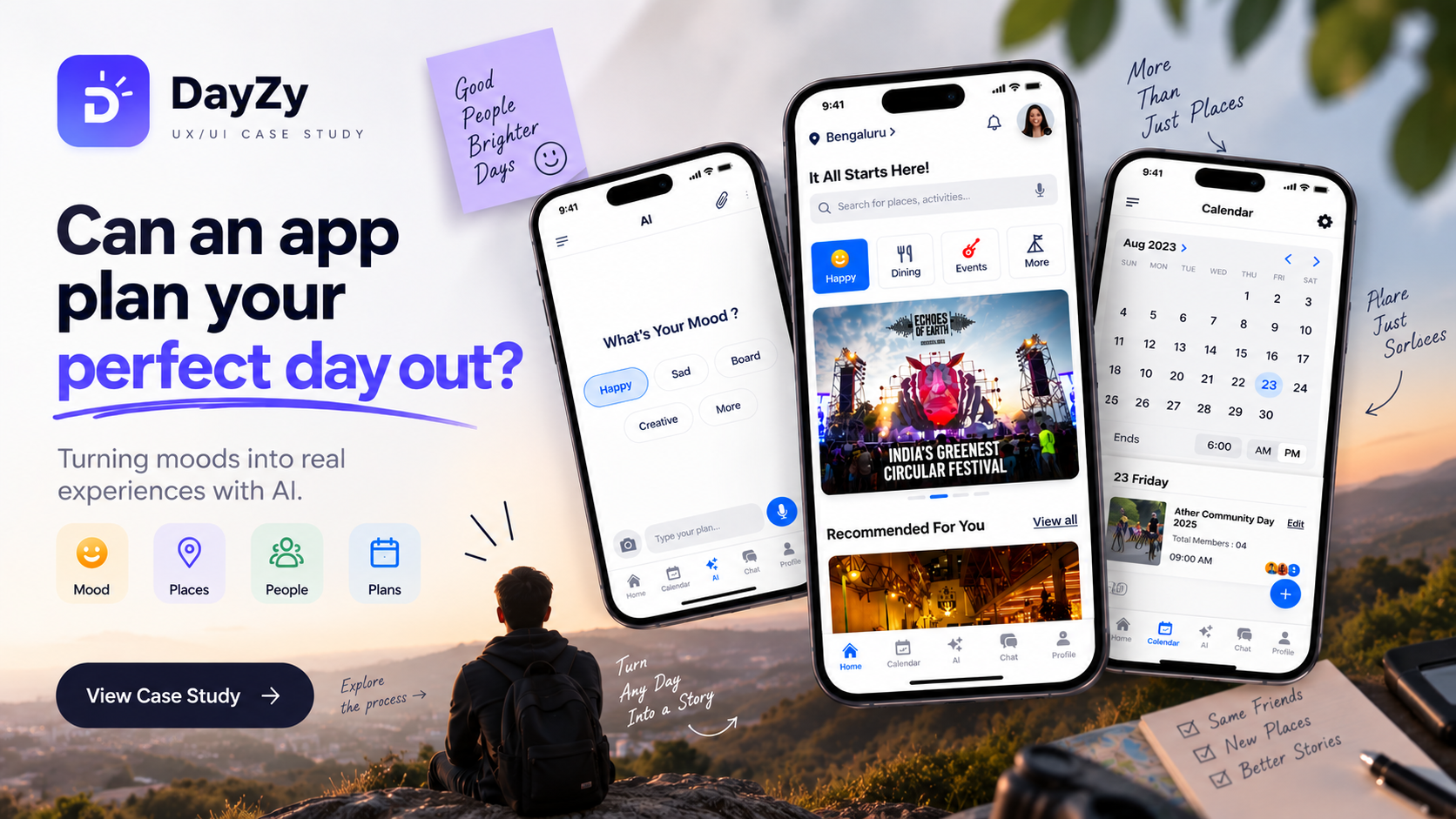
DayZy AI: Making day-out planning simple, smart, and social
An AI-powered day-out planning concept that acts as a co-planner: from mood and context to a suitable, practical plan instead of endless searching across apps.
- Role
- UI/UX Designer
- Team
- Team of five
- Duration
- 6 months
- Status
- Completed
- Tools
- Figma and FigJam
Outcome: A concept/course project that shifts the experience from Search → Compare → Decide to Mood → Context → Recommendation → Plan → Experience. This was not a production product; no business metrics are claimed.
Problem context
What was actually going wrong
What problem existed
Planning a day out involves deciding what to do, choosing where to go, considering mood and group preferences, checking distance and travel, comparing options, gathering useful information and coordinating with others.
Who experienced it
College students, working professionals and non-working individuals in Bangalore and other cities/towns across Karnataka; the product was envisioned for Indian users more broadly.
Why it mattered
Information exists across multiple platforms, and the user becomes the connector between all those systems. The challenge isn't finding more places — it's deciding what to do next.
What was known
Five-member team research with 8–10 participants using qualitative and quantitative methods, covering mood, location, distance, travel, time, group and suitability, plus competitive analysis.
What still needs validation
Task completion, time to decision, recommendation relevance, planning effort, group decision time, confidence, recommendation acceptance and information sufficiency — all metrics to be validated.
Research lens
How people planned day-outs before DayZy.
- Before DayZy, planning was distributed across different digital platforms.
- A typical journey: Discover a place → Check reviews → Check location → Discuss with friends → Compare → Check travel → Decide.
- The information existed. The user had to connect it.
Research lens
The people, places, and context shaping day-out decisions.
- Primary research environment: Bangalore, Karnataka, India.
- Research participants included college students, working professionals and non-working individuals, from Bangalore and other cities/towns across Karnataka.
- The product was envisioned for Indian users more broadly.
- Device: mobile. Context: Indian lifestyle, social discovery, day-out planning and AI recommendation.
Research lens
Understanding the friction between discovering options and making a plan.
- Core journey: Set Mood / Intent → Get Relevant Experiences → Explore & Compare → Check Context → Plan With Group → Finalize → Book / Go.
- Top tasks: decide what to do, find an experience that fits the context, turn the choice into a plan.
- Major friction: choice overload, fragmented information, group decision-making, distance and travel, insufficient decision context.
- Core friction: the user gets stuck between discovering possibilities and committing to one practical plan.
- Simplification: Feel → Understand → Choose → Plan → Go, instead of Search → Browse → Compare → Switch apps → Discuss → Re-search → Decide.
Research lens
How emotions, trust, and AI shape the planning experience.
- Starting emotion: uncertain — with confusion, frustration, decision fatigue and timing anxiety along the way.
- Trust issue: trusting AI-generated recommendations.
- Desired emotional progression: Uncertain → Curious → Reassured → Confident → Excited.
- Visual direction: blue + green, aiming for trust, freshness, positivity and exploration.
- Interaction: guided decision-making instead of endless searching.
Research lens
How users search, compare, discuss, and eventually decide.
- Existing behaviour: Search → Compare → Check reviews → Check distance → Ask friends → Find another option → Compare again → Decide.
- Workaround: users combine discovery platforms, maps, reviews, messaging apps and booking/information platforms.
- Habit loop: Trigger → Search → Compare → Discuss → Uncertainty → Search again → Decision.
- Desired behaviour: tell DayZy what kind of experience you're looking for → review relevant options → choose → plan.
- Feedback loop: Mood → Recommendation → User choice → Plan → Experience → Feedback. The concept does not assume AI perfectly understands emotions.
Research lens
What the research tells us.
- Research sample: 8–10 participants (qualitative and quantitative methods).
- Usability testing: not yet established / not conducted.
- Task completion: not quantitatively measured.
- Time saved: not quantitatively measured.
- Errors: not measured. Confidence: not formally measured. Business impact: not measured.
- Metrics to be validated: task completion rate, time to decision, recommendation relevance, planning effort, group decision time, confidence, recommendation acceptance, information sufficiency.
Design engineering
The process, as it actually ran
Steps marked as pending were not part of this project. They are shown so the gaps stay visible.
Research — completed
8–10 participants, qualitative and quantitative methods, studying outing-planning behaviour.
Analysis — completed
Analysed mood, location, distance, travel, time, group and suitability as decision inputs.
Competitive analysis — completed
Reviewed existing discovery, review, maps and booking platforms.
Mood-first approach — completed
Explored mood and context as the starting point instead of search.
UX & IA — completed
Structured the user experience and information architecture.
AI as co-planner — completed
Designed AI interaction as a co-planner the user can guide and correct.
Mobile UI — completed
Created the mobile interface.
Interactive prototype — completed
Built an interactive prototype of the experience.
Usability testing — pending
Not yet established / not conducted.
STAR story
Situation, Task, Action, Result
Situation
Planning a day out often requires users to search, compare, check reviews, evaluate distance, discuss options and decide — across multiple platforms.
Task
Explore how to reduce decision-making friction and help users move from 'I want to go out' to a suitable and practical plan.
Action
- As part of a five-member team, researched 8–10 participants using qualitative and quantitative methods.
- Studied outing-planning behaviour and analysed mood, location, distance, travel, time, group and suitability.
- Conducted competitive analysis and explored a mood-first approach.
- Structured the UX and IA, designed AI as a co-planner, created the mobile UI and an interactive prototype.
- Independently developed the DayZy concept from the identified problem space.
Result
DayZy shifts the experience from Search → Compare → Decide to Mood → Context → Recommendation → Plan → Experience. This was a concept/course project, so no production metrics or business impact are claimed. The strongest result is the design learning: the opportunity wasn't simply to help users find more places, but to help them make a better decision about what to do next.
Research lens
Testing
What was tested, with whom, and what was and wasn't measured.
- Research with 8–10 participants using qualitative and quantitative methods, in Bangalore and across Karnataka.
- Competitive analysis of existing discovery, review, maps and booking platforms.
- Usability testing was not conducted, so task completion, time to decision, recommendation relevance and confidence remain unmeasured.
Research lens
Iteration
What changed after feedback, and the reasoning behind each change.
- Moved the entry point from search to mood after research showed the blocker was deciding, not finding.
- Reframed AI as a co-planner the user can guide and correct, rather than an assistant that claims to read emotions.
- Brought distance, travel and group context into the recommendation itself so users stop switching between apps.
Research lens
Impact
The honest outcome measured where it exists, marked as unvalidated where it doesn't.
A concept/course project no production or business impact is claimed. Metrics to be validated: task completion rate, time to decision, recommendation relevance, planning effort, group decision time, confidence, recommendation acceptance and information sufficiency. This information was not supplied for this project and has not been invented. — this information was not supplied for this project and has not been invented.
Before & after
What changed, and why
Before
Search → Browse → Compare → Switch apps → Discuss → Re-search → Decide — the user connects fragmented information across platforms.
After
Feel → Understand → Choose → Plan → Go — guided decision-making from mood and context to one practical plan.
- What changed
- Planning shifted from searching across platforms to a guided path from mood to plan.
- Why it changed
- The user gets stuck between discovering possibilities and committing to one practical plan; the challenge is deciding, not finding.
- Supporting evidence
- Impact to be validated — concept/course project, not measured in production.
Final screens
The interface
Key screens from the final design.
Field Research
Taking research beyond the screen
Our five-member team conducted field research in Bengaluru with a student and an IT professional.
My first field experience taught me how to listen, observe reactions, and understand the context behind people's answers.
From research to design, the conversations helped us challenge our assumptions and shape our DayZy solution.
Learnings
What this project taught me
- The opportunity wasn't simply to help users find more places, but to help them make a better decision about what to do next.
- AI is only useful here if the user can guide and correct it quickly; the interaction matters more than the model.
- Reducing the number of decisions is itself the feature.
Next project
Togile CRM